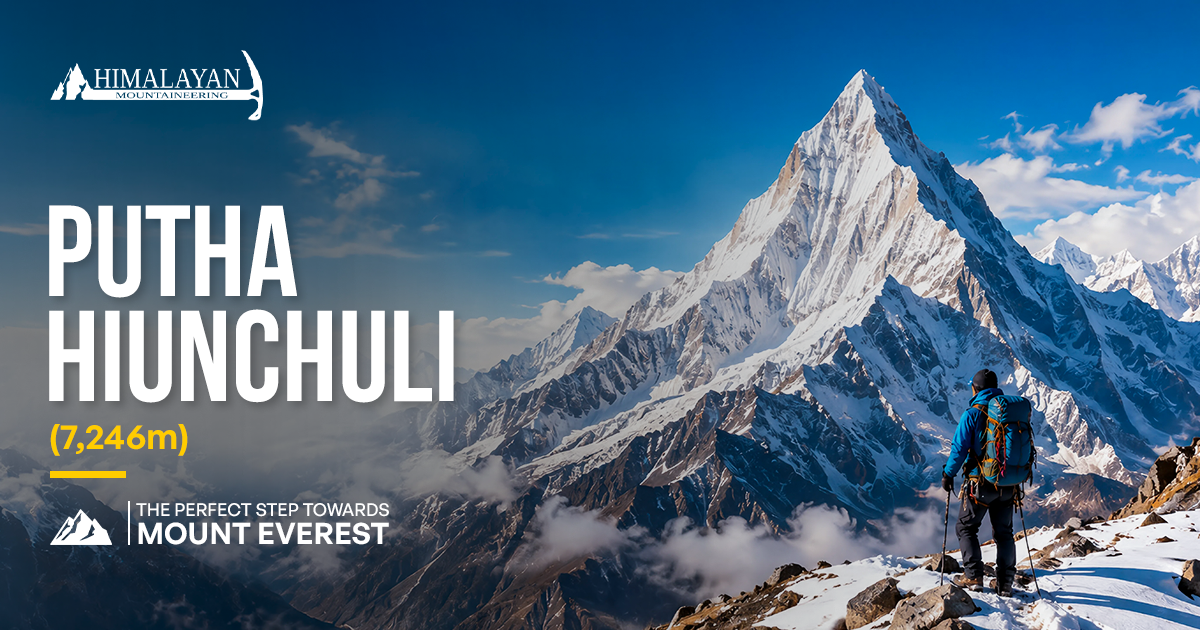
Putha Hiunchuli (7,246m): The Perfect Step towards Mount Everest
Himalayan Mountaineering
Mountaineering | Expedition Planning | Dhaulagiri Range, Nepal
A Different Kind of Himalayan Objective
Putha Hiunchuli asks for the patience, altitude judgment, and technical discipline of a serious Himalayan mountaineer, set in one of the quieter corners of the Dhaulagiri range. It is that combination — an achievable technical grade paired with a genuine extreme-altitude challenge — that makes it worth attempting, and why it remains a respected objective among climbers who have already proven themselves at 6,000m and beyond.
Putha Hiunchuli Expedition
Putha Hiunchuli — the westernmost peak of the Dhaulagiri range, also known as Dhaulagiri VII — stands at 7,246 metres in a remote, lightly travelled corner of west-central Nepal. It is climbed by relatively few expeditions each year, which is part of its appeal: broad, moderate-angled upper slopes, a comparatively achievable technical grade for a 7,000-metre peak, and a quiet, uncrowded route through one of the least-visited sections of the Himalaya.
This is not a mountain that demands extreme technical climbing, but it is not an easy one either. Success depends on sound acclimatisation, glacier travel competence, careful route judgment, and the physical reserve to complete a multi-week expedition at extreme altitude. This guide looks at what a Putha Hiunchuli expedition actually involves — technically, physiologically, and in terms of planning — for climbers considering it as a serious 7,000m objective.
Why Putha Hiunchuli Is a Distinctive Himalayan Objective
Most 7,000-metre expeditions are built around the same core structure: a graduated acclimatisation programme, a series of camp rotations, and a summit push timed to a weather window. Putha Hiunchuli follows that same structure, but its character sets it apart from steeper, more compartmentalised Himalayan routes.
The upper mountain's broad, relatively even slopes make the climb more of a sustained physical and altitude challenge than a technical one, at least by Himalayan standards. That does not make it a minor undertaking. Long summit days, exposure to wind and cold at extreme altitude, and glaciated terrain with real crevasse hazards all demand the same discipline and preparation as any serious 7,000m peak. What makes Putha Hiunchuli distinctive is the combination of a moderate technical grade with a genuinely remote, low-traffic setting in the western Dhaulagiri range.
Nepal’s New Everest Rule and Why It Matters
Nepal is moving toward stricter rules for Mount Everest climbers. Proposed regulations require aspirants to have successfully summited a 7000-metre peak within Nepal before applying for an Everest permit. This change aims to improve safety and ensure climbers have sufficient high-altitude experience.
Putha Hiunchuli is an excellent choice to fulfil this upcoming requirement. It delivers the necessary altitude, an official Nepali summit certificate, and valuable expedition experience in a less crowded environment. Climbers who complete Putha Hiunchuli gain both the formal qualification and the practical skills needed for bigger objectives like Everest.
What Makes Climbing Above 7,000m Physically and Technically Demanding
Climbing at 7,246 metres is not simply a longer version of trekking or lower-altitude mountaineering — it is a different physiological and technical environment.
• Extreme altitude changes everything the body does. Oxygen availability above 7,000m drops to roughly two-fifths of sea-level values, and reaction time, coordination, and decision-making all measurably slow.
• Fatigue compounds technical error. A climber who has spent hours moving upward on a summit push is working with depleted energy reserves and slowed reflexes — exactly the conditions in which a misstep on exposed terrain becomes serious.
• The upper mountain is rarely uniform. Wind-affected snow, sun crust, and exposed ice can all appear within a single section of the route, often unclear until a climber is already on it.
• There is no quick rescue margin. At this altitude and in this remoteness, an injury is a serious problem long before it becomes a manageable one — evacuation options are limited and slow.
None of this makes the climb unreasonable for a well-prepared team. It makes careful, conservative decision-making a core part of the expedition, not a formality assumed away once camps are stocked.
Snow and Route Conditions on Putha Hiunchuli
Snow and terrain conditions shape more of this expedition than almost any other factor — more than fitness, and arguably more than weather forecasting alone. A route that is straightforward one week can present a difficult mix of wind-scoured ice and unstable snow the next.
• Wind slab, formed when wind deposits and compacts snow on lee slopes — often stable enough to climb, but prone to sudden failure if the bond to the layer beneath it is weak.
• Sun crust, a hardened surface layer formed by repeated freeze-thaw cycles, which can make cramponing more difficult and increase fall risk on steeper sections.
• Breakable crust over softer snow, one of the more physically punishing conditions to move through, especially at altitude where the extra effort accelerates fatigue.
• Crevassed glacier sections, particularly where seasonal snow cover is thin, require careful route-finding and, at times, roped travel even on ground that looks straightforward.
This is why a responsible operator does not present Putha Hiunchuli as a mountain with a single, fixed route each season. Conditions, snowfall, and avalanche hazard vary year to year, and route decisions have to be made on the mountain, based on what the team can see and assess directly — not assumed in advance.
Technical Skills Required for a Putha Hiunchuli Expedition
Putha Hiunchuli is not the place for a first Himalayan expedition. It rewards climbers who arrive with a specific set of skills already in place, developed well before reaching Base Camp:
• Fixed-line climbing competence, including efficient use of an ascender, comfort on exposed sections, and the stamina to move on fixed lines over multiple consecutive days.
• Glacier travel and crevasse awareness, including rope work, since much of the route crosses glaciated terrain where hazards are not always visible from the surface.
• Crampon and ice axe technique, solid enough to be automatic in low-oxygen, cold-hands conditions rather than requiring conscious effort.
• Basic snow and terrain assessment, enough to help read aspect, wind-loading, and layering, and to support an informed go/no-go call on a given section.
• Self-arrest and fall management, since a slip on steep, firm snow at altitude behaves very differently from a fall on lower-angle terrain.
• Multi-week expedition experience, including the discipline of camp rotations, rest days, and pacing over a sustained high-altitude climb.
This combination — solid technical mountaineering layered on genuine high-altitude expedition experience — is what separates climbers who are ready for Putha Hiunchuli from those who are better served by a more introductory 6,000m objective first.
Acclimatisation and the Physiological Demands Above 7,000m
Above 7,000 metres, the body is operating in what mountaineers call extreme altitude. Oxygen availability drops to roughly two-fifths of sea-level values, sleep quality deteriorates, appetite suppresses, and cognitive processing measurably slows. These effects apply to every climber on the mountain, and they are the single biggest factor in whether an expedition succeeds.
A structured acclimatisation programme — progressive rotations through intermediate camps, deliberate rest days, and a conservative summit-push strategy — is the foundation of the entire expedition. Rushing this process is the most common reason capable, fit climbers fail to summit, or worse, develop altitude illness serious enough to require immediate descent.
Equipment for a Putha Hiunchuli Climb
A well-run Putha Hiunchuli expedition depends on a complete, carefully chosen high-altitude kit — nothing exotic, but nothing that can be skipped either.
• Climbing equipment: high-altitude mountaineering boots, crampons, ice axe, harness, and standard fixed-line hardware (ascender, carabiners, and slings) for the fixed sections of the route.
• Glacier travel gear: climbing rope, snow anchors, and crevasse rescue equipment carried and used as a matter of routine on glaciated sections.
• Cold and altitude protection: a high-altitude down suit or equivalent layering system, glacier glasses and goggles, and, depending on the season and team strategy, supplemental oxygen for the summit push.
• Communication and navigation: a satellite communication device, GPS, and route-finding tools appropriate for a remote, largely unmarked upper mountain.
• Camp and expedition logistics: four-season tents rated for extreme wind and cold, high-altitude sleeping systems, and a stove setup reliable at low temperature and reduced oxygen.
The equipment list reflects what the objective really is: a full 7,000m expedition in a remote setting, where every system has to work reliably with no easy resupply if something is missing or fails.
How Expeditions Assess Route and Weather Conditions
The decision to proceed on a given day — whether toward the summit or through a specific section of the route — is not made far in advance. It is made continuously, based on a combination of factors that experienced guides evaluate as the climb progresses:
• Recent snowfall and wind history, which determine loading patterns and the likelihood of unstable snow on lee aspects.
• Temperature trends, since freeze-thaw cycling changes surface conditions from one day to the next, sometimes significantly.
• Visible terrain hazards, including crevasses, exposed rock bands, and sections where a fall would be difficult to arrest.
• Weather forecasting and wind exposure, with particular caution around the summit ridge, where conditions can change quickly.
• The physical and mental state of the team, honestly assessed — fatigue, hydration, and altitude symptoms all factor into whether a summit attempt should proceed.
When conditions do not support a safe attempt — for one section or for the whole upper mountain — the sound decision is to wait, reroute, or turn back, and that has to be treated as a legitimate outcome of the expedition, not a failure of it. The mountain, the weather, and the season decide how the climb unfolds; the itinerary is a plan, not a guarantee.
Who Is Qualified for a Putha Hiunchuli Expedition
Putha Hiunchuli is not a beginner's introduction to high-altitude mountaineering — it is an objective for climbers who already have a demonstrated base of expedition experience.
• Climbing background: prior experience on a 6,000m or 7,000m peak, including comfort with fixed-line climbing, glacier travel, and multi-week expedition acclimatisation.
• Physical conditioning: the cardiovascular and muscular endurance to sustain a demanding multi-day ascent, including consecutive long summit-push days.
• Cold-weather resilience: prior experience managing extended exposure to extreme cold and wind, including overnight camps well above 6,000m.
• Judgment under pressure: the ability to make a clear-headed go/no-go call while fatigued and at extreme altitude — arguably the single most important qualification of all.
For climbers who meet that profile, Putha Hiunchuli is often described as a serious but attainable step — a genuine 7,000m objective without the extreme technical difficulty or crowding of the highest-profile Himalayan peaks.
Why This Objective Appeals to Experienced Himalayan Climbers
There is a relatively short list of Himalayan peaks where altitude, terrain, and logistics align to offer a genuine 7,000m objective without extreme technical difficulty. Putha Hiunchuli's broad upper slopes, its comparatively moderate technical grade, and its remote, quiet setting in the western Dhaulagiri range put it firmly on that list.
For experienced climbers, that combination is the appeal: a mountain that is achievable without extreme technical difficulty, but that still demand genuine expedition skill, sound judgment, and physical resilience — set in a part of the Himalaya shaped by the season, not by hundreds of prior expeditions.
Interested in joining a future Putha Hiunchuli Expedition with Himalayan Mountaineering?
Explore our upcoming departures or get in touch with our team to start planning your climb.
Contact us at: info@himalayanmountaineering.com or do visit our page www.himalaynmountaineering.com
FAQs about Climbing Putha Hiunchuli ( Himalayan Mountaineering )
How difficult is Putha Hiunchuli to climb?
Putha Hiunchuli is considered one of the more moderate 7,000m peaks in the Himalaya from a technical standpoint, thanks to its broad, relatively even upper slopes. That said, extreme altitude, glaciated terrain, and long summit days still make it a serious mountaineering objective that demands prior high-altitude experience.
What is the best season to climb Putha Hiunchuli?
The pre-monsoon (spring, April–May) and post-monsoon (autumn, September–October) windows are generally considered the most favourable, offering more stable weather and predictable snow conditions than the monsoon or winter months.
Do I need supplemental oxygen for Putha Hiunchuli?
Many climbers summit without supplemental oxygen given the mountain's moderate technical grade, but this depends on individual acclimatisation, prior high-altitude experience, and the team's overall strategy. Some expeditions carry oxygen as a safety reserve for the summit push regardless.
What prior experience is recommended before attempting Putha Hiunchuli?
Prior experience on at least one 6,000m or 7,000m peak is strongly recommended, including comfort with fixed-line climbing, glacier travel, crevasse-rescue basics, and multi-week expedition acclimatisation. This is not considered a suitable first Himalayan expedition.
How long does a typical Putha Hiunchuli expedition take?
Most expeditions run four to five weeks in total, accounting for trekking to Base Camp, a staged acclimatisation programme with camp rotations and rest days, and a weather-dependent summit window.
Is a permit required to climb Putha Hiunchuli?
Yes. Putha Hiunchuli requires a climbing permit issued by Nepal's Department of Tourism, along with the standard trekking and conservation area permits for the approach route, typically arranged by the expedition operator.
What is the main hazard on Putha Hiunchuli?
Extreme altitude is the primary factor in whether an expedition succeeds, followed by glacier travel hazards such as crevasses and variable snow conditions on the upper mountain, including wind slab and breakable crust.